

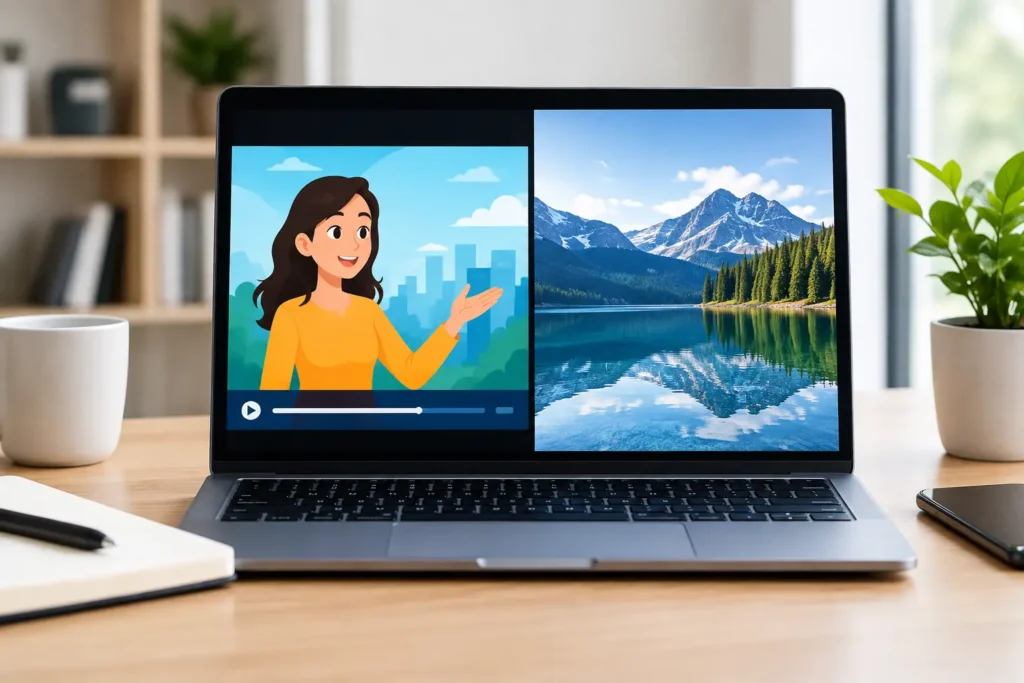
A product page can explain every feature and still leave prospects asking one basic question: what does this actually do for me? That is where the choice between animated video versus static content becomes a business decision, not simply a creative preference. Both formats can support a strong brand. The better option depends on the message, the audience’s intent, and the action you need people to take next.
Static content is efficient, scannable, and often essential. Animation adds movement, pacing, and narrative control when a message needs more explanation than a headline or graphic can carry. The most effective marketing teams do not treat this as an either-or debate. They assign each format a clear job.
Animated Video Versus Static Content: The Core Difference
Static content communicates information in a fixed frame. Think social graphics, product screenshots, diagrams, infographics, display ads, sales sheets, and website images. Its strength is immediacy. A viewer can scan a benefit, compare an option, or absorb a brand message in seconds.
Animated video controls the sequence of information. It can show a problem before introducing a solution, move from a confusing process to a clear outcome, and combine visuals with voice-over, sound, and on-screen text. That structure is especially valuable when the audience must understand how something works before they are ready to buy.
The difference is not that animation is automatically more engaging. Poorly paced animation with a vague script will lose attention quickly. Likewise, a focused static visual can make a stronger impression than a 90-second video when the offer is simple. The real advantage of motion is its ability to guide understanding over time.
When Attention Needs Direction, Animation Has an Edge
Movement naturally draws the eye, but attention is only useful if it is directed toward a relevant point. A well-produced explainer video can lead a viewer from a familiar pain point to a product benefit without forcing them to interpret a dense block of copy or a complex visual on their own.
This matters for businesses selling software, professional services, technical products, healthcare solutions, financial services, or new categories. These offers often require context. A static image may show the product interface, but animation can demonstrate the workflow, clarify the value, and show the transformation in one connected story.
For example, a cybersecurity company may need to explain how a threat is detected, contained, and reported. A single infographic can communicate the broad process. An animated video can make the sequence easier to follow while reinforcing the business outcome: less risk, faster response, and greater visibility.
Animation is also useful when your audience is cold or distracted. In paid social campaigns, trade show displays, landing-page hero sections, and sales presentations, motion can earn the extra few seconds needed to communicate why the message deserves attention.
Static Content Wins When Speed Is the Priority
Not every message needs a storyline. If your audience already understands the category and needs a quick reason to click, download, or compare, static content may be the more effective choice.
A clear promotional graphic can announce a limited-time offer faster than a video. A product comparison chart can help a buyer evaluate options without watching a full explanation. A sharp customer quote, paired with a recognizable visual identity, can reinforce trust in an email or LinkedIn post with very little friction.
Static assets are also practical for high-volume content needs. Marketing teams often need multiple ad sizes, social variations, sales enablement materials, and campaign updates. Once a visual system is established, static designs can be adapted quickly and cost-effectively.
That does not make static content the lower-value option. It makes it a precision tool. Use it when the message is already clear, the action is straightforward, and the viewer needs information at a glance.
Clarity Is the Real Conversion Factor
Many brands choose animation because they want more engagement. A stronger reason is clarity. Engagement without comprehension does not move a prospect closer to a decision.
Static content asks viewers to assemble the story themselves. That can work well for simple ideas, familiar products, and audiences with high intent. Someone searching for pricing, specifications, or a particular feature may prefer a direct visual and concise copy over a video introduction.
Animated video reduces that interpretation burden. It can introduce one idea at a time, show relationships between concepts, and use narration to explain what viewers are seeing. For abstract services, complicated workflows, and technical innovations, that progression can turn uncertainty into confidence.
The script matters more than the animation style. Before choosing 2D motion graphics, 3D animation, whiteboard video, or another format, define the one message the audience must retain. If the central promise is unclear on paper, additional motion will not solve the problem.
Cost, Lifespan, and Production Trade-Offs
Static content usually has a lower upfront cost and a faster turnaround. It is easier to revise a headline, swap a product photo, or update a call to action. That flexibility makes it a smart choice for fast-moving campaigns and frequent testing.
Animation typically requires more planning. Scripting, storyboarding, visual development, voice-over, sound design, and animation all contribute to the final result. The investment is higher because the asset does more work. A strong explainer can support your homepage, sales outreach, product launches, presentations, paid media, and onboarding efforts.
However, animation has a shelf-life consideration. If a product interface, pricing model, or positioning is likely to change next quarter, avoid building the entire video around details that will quickly become outdated. Keep the core story focused on lasting customer problems and use modular scenes where possible.
The best value does not always come from choosing the least expensive asset. It comes from matching the production level to the revenue opportunity. A sales-critical video for a complex, high-value service deserves more strategic development than a one-week social announcement.
How to Choose the Right Format for the Message
Start with the audience’s current level of understanding. If they need to learn what your product is, how it works, or why it is different, animation is often the better starting point. If they already know the basics and need a quick proof point, promotion, or reminder, static content can be more efficient.
Next, consider the channel. Website visitors may be willing to watch a concise product overview, especially when it answers a question that brought them to the page. Social audiences may respond better to short motion clips supported by static posts that reinforce one benefit at a time. Sales teams can use animated explainers to create consistency in early conversations, then rely on static one-pagers and diagrams for detailed follow-up.
Finally, define the desired action. Animation is well suited to building understanding, creating emotional momentum, and introducing a solution. Static assets are excellent for driving a focused next step, such as reviewing a feature list, registering for a webinar, or requesting a quote.
A practical content system often uses both. Create one foundational animated video to establish the story, then extract its key messages into static campaign visuals, carousels, diagrams, and sales materials. This approach keeps your message consistent while giving each channel a format that fits how people use it.
Make Animation Earn Its Place
Animation should not be added just because competitors are using it. It should earn its place by making a message easier to understand, more memorable, or more persuasive. That means beginning with the business objective, not the visual effect.
At AnimateWiz, the strongest animation projects start by identifying the audience question that is blocking action. From there, the creative work has a clear purpose: simplify the message, show the value, and give viewers a reason to move forward.
Choose static content when speed and instant comprehension matter most. Choose animated video when your audience needs to see the story unfold. The right asset is the one that makes the next decision feel simpler for the person on the other side of the screen.