

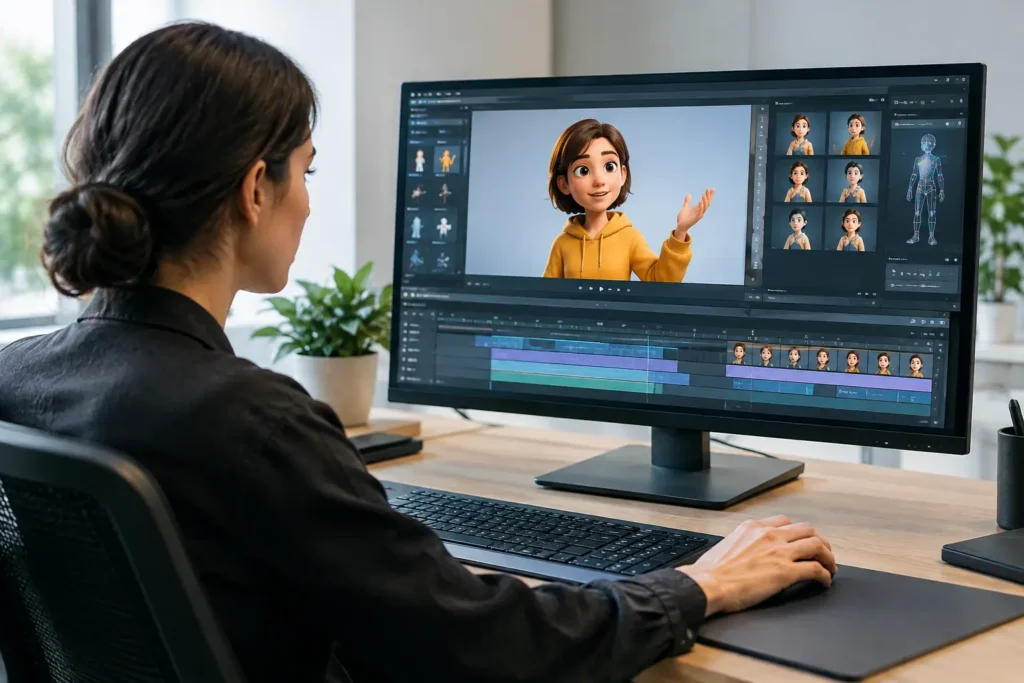
A product animation can fail long before the first frame reaches the screen. The script may be unclear, the visual direction may not match the brand, or feedback may arrive too late to fix the story efficiently. That is why AI animation workflow trends matter to business teams. The value is not simply faster production. It is the opportunity to make stronger creative decisions earlier, reduce repetitive work, and keep the final video focused on audience understanding and conversion.
For brands investing in explainers, product videos, motion graphics, or 3D animation, AI is becoming part of the production process rather than a replacement for it. The most effective workflows combine automation with experienced creative direction. AI can generate options quickly. A skilled team determines which option supports the message, protects the brand, and earns attention.
AI Animation Workflow Trends Are Moving Upstream
Early AI tools were often used at the end of production for quick visual experiments or social cutdowns. Now, the biggest impact is happening before animation begins. Teams are using AI to accelerate research, organize source material, test story angles, and create early visual references.
This shift matters because animation is expensive to change once production is underway. Revising a concept during script development is far more efficient than rebuilding scenes after voice-over, illustration, or 3D modeling have started. AI can help teams turn a dense brief, technical product description, or collection of stakeholder notes into a workable first draft. It can also identify gaps in the message, such as an undefined audience problem or a feature that has not been translated into a customer benefit.
That does not mean a first draft should become a final script. Generic language is still one of the biggest risks in AI-assisted content. Business audiences recognize vague claims quickly. A persuasive animation needs a point of view: who the viewer is, what is frustrating them, why the existing approach falls short, and what changes with the product or service being presented.
Better Briefs Create Better AI Outputs
The companies seeing the best results are not asking a tool to create a video from a one-line prompt. They start with a clear creative brief that defines the audience, objective, distribution channel, brand personality, key proof points, and desired next step.
With that context, AI can support ideation without flattening the brand. It may suggest several ways to visualize a complex workflow, condense a long product explanation into a tighter narrative, or generate alternate hooks for a paid campaign. The creative team can then select the strongest direction and develop it with intention.
Script and Storyboard Development Are Becoming More Iterative
Animation projects have always benefited from early alignment. AI is making that alignment easier by helping teams explore multiple script structures and storyboard directions before committing to one path.
For example, a SaaS company launching a technical platform may need to explain a complicated process in 60 seconds. AI can help surface several narrative approaches: problem-solution, before-and-after, customer journey, feature demonstration, or metaphor-led storytelling. The right choice depends on the campaign goal. A homepage explainer may require immediate clarity, while a sales presentation can support more detail and product-specific proof.
Storyboarding is changing in a similar way. Generative image tools can produce rough style references and composition ideas at speed. This gives stakeholders something more concrete to react to than a written description alone. It can reduce the familiar feedback cycle of, “That is not quite what I pictured.”
Still, rough references are not finished assets. They may contain inconsistent objects, impractical camera angles, or visual details that cannot be reproduced cleanly across a full sequence. Professional storyboarding remains essential because it considers pacing, transitions, hierarchy, animation feasibility, and how each scene advances the message.
Faster Asset Creation Does Not Eliminate Design Standards
One of the most visible AI animation workflow trends is faster asset generation. Teams can create background concepts, texture explorations, prop ideas, image variations, and draft visual elements in a fraction of the time once required for manual experimentation.
This can be especially useful when a campaign needs multiple formats or audience-specific versions. A core visual concept can inform cutdowns for social media, sales outreach, paid advertising, onboarding, and event screens. AI-assisted adaptation helps increase the value of the original production without forcing the team to rebuild every asset from scratch.
The trade-off is consistency. Generated visuals often look impressive as single images but lose credibility when placed next to approved brand materials. Colors drift. Typography becomes unreliable. Product interfaces may be inaccurate. Characters can change from scene to scene. For a business video, these details are not minor. They affect trust.
The answer is a controlled visual system. Brand-approved color palettes, type rules, icon styles, product screenshots, 3D references, and design templates give AI-supported production a dependable foundation. The more distinctive the brand, the more important that foundation becomes.
AI Is Improving Production Efficiency Behind the Scenes
Some of the highest-value uses of AI are less visible to the audience. Production teams can use it to organize project files, transcribe interviews, create caption drafts, tag footage, summarize feedback, and identify repeated revision requests. These tasks do not usually make the creative concept stronger on their own, but they give designers, animators, and producers more time to focus on work that does.
Voice-over workflows are also evolving. AI voices can be useful for internal animatics, early timing tests, or low-risk content where speed matters more than vocal nuance. They allow a team to validate pacing before paying for final recording and sound design.
For customer-facing brand animation, however, a professional voice actor often remains the stronger choice. Human delivery brings emphasis, restraint, warmth, and credibility that are difficult to direct consistently through synthetic voices. The decision depends on the audience and the stakes. A quick internal training draft has different requirements than a flagship launch video intended to build confidence with enterprise buyers.
Quality Control Is Becoming a Strategic Advantage
As AI makes content easier to produce, polished execution becomes more valuable, not less. Viewers will see more animated content, more often. The work that stands out will be accurate, focused, and unmistakably aligned with the brand.
Quality control now needs to cover more than grammar and visual polish. Teams should review factual claims, product representations, licensing and usage rights, accessibility, brand compliance, and cultural appropriateness. This is particularly important in regulated industries, technical categories, and B2B sales environments where one misleading visual can create confusion or undermine credibility.
Approval workflows should also become more deliberate. Instead of sharing an almost-finished video with every stakeholder at once, establish sign-off points for strategy, script, storyboard, design direction, animation, and final delivery. AI can make revisions faster, but it cannot solve conflicting feedback or an undefined decision-maker.
What Business Teams Should Change Now
The practical opportunity is not to replace a production partner with a collection of tools. It is to build a workflow that gets the right work done faster. Start by identifying where your current animation process loses time. It may be unclear briefs, slow stakeholder approvals, repeated script revisions, or a lack of reusable visual assets.
Then decide which tasks benefit from AI assistance and which require experienced judgment. AI is well suited to research synthesis, early concepts, transcription, versioning, caption drafts, and administrative production tasks. Brand strategy, final scripts, visual systems, character performance, motion design, sound direction, and quality assurance still demand human expertise.
It also helps to plan for reuse from the beginning. A well-produced animation should not live in one location for one campaign. With the right source files and creative architecture, the same message can support shorter ads, sales clips, social posts, presentation visuals, and onboarding content. This approach improves production efficiency while keeping every asset connected to the same core story.
The Best Workflow Keeps the Message in Control
AI will continue to change how animation is planned and produced. Some tasks will become faster, and expectations for turnaround will rise with them. But speed is only useful when it supports clarity.
For businesses, the strongest path is to use AI as a creative accelerator inside a disciplined production process. At AnimateWiz, that means beginning with the audience and business goal, then building a visual story that makes the message easier to understand, remember, and act on.
The next time you plan an animated video, ask a more useful question than whether AI can make it faster: will this workflow give your audience a clearer reason to care?