

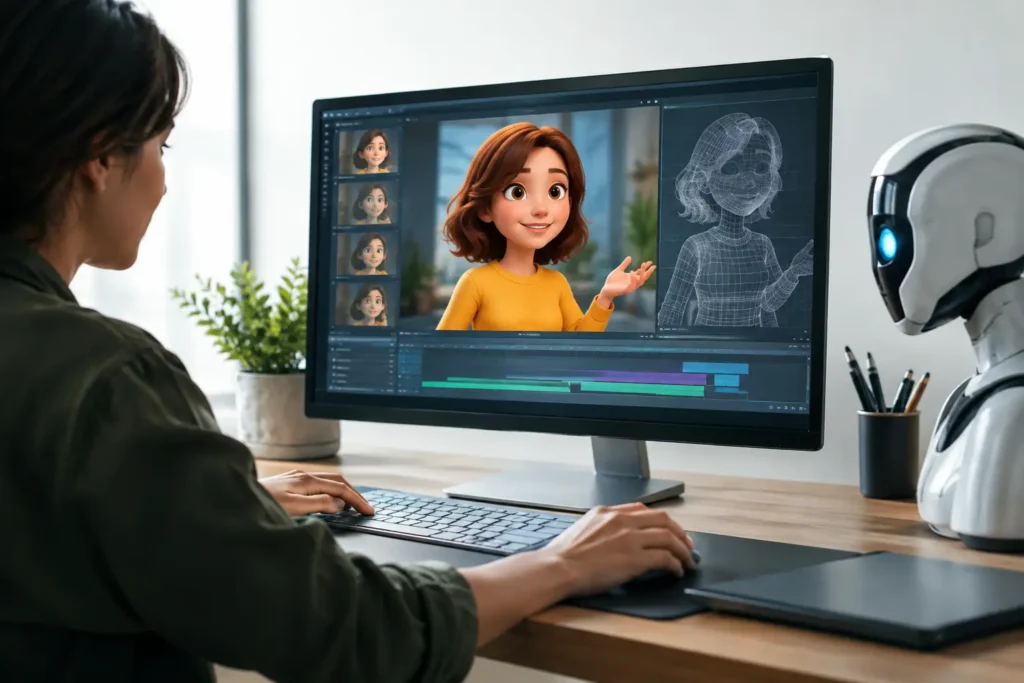
A 60-second product video can look polished, use impressive effects, and still leave prospects asking one question: “What does this actually do?” That is the real test for business animation. AI in animation production can help teams move faster, but only when it supports a clear message, a strong creative strategy, and a production process built around the audience.
For marketing teams under pressure to create more content, AI is changing what is possible within a realistic timeline and budget. It can reduce repetitive work, generate early visual directions, and help adapt a campaign for multiple formats. It cannot, by itself, determine what your buyers need to understand before they take action.
AI in Animation Production Is a Workflow Shift
AI is not one tool or one type of output. In an animation workflow, it may support scripting, concept development, storyboard creation, voice generation, image creation, motion assistance, editing, captioning, and localization. The strongest use cases are usually the least glamorous: tasks that consume production time without adding much strategic value.
For example, an AI-assisted process can help a team create several storyboard approaches before committing to a visual direction. It can identify places where a script is too technical, produce a first pass of captions, or organize a rough edit around a voice-over track. Those efficiencies give writers, designers, and animators more time to focus on the work viewers actually notice: pacing, visual clarity, brand fit, and storytelling.
That distinction matters. A marketing video is not successful because it was produced quickly. It is successful because it makes the right idea easier to understand and more persuasive to the right audience.
Where AI can save meaningful time
Pre-production is often where AI has the most practical value. Teams can use it to summarize source materials, explore hooks for different audience segments, turn a long brief into an initial script structure, or create reference boards for a creative kickoff. These outputs should be treated as working material, not as final deliverables.
During production, AI can assist with rotoscoping, asset cleanup, background variations, lip-sync support, transcription, and versioning. In post-production, it can accelerate caption creation, format a video for vertical or social placements, and create localized text options for regional campaigns.
The benefit is not simply lower cost. It is faster iteration. When teams can test a scene, revise a message, or prepare campaign variations without rebuilding everything from scratch, they make better decisions earlier.
What still needs human judgment
AI does not know your positioning unless someone defines it. It does not understand the difference between a technical buyer who needs proof and an executive buyer who needs a concise business case. It cannot reliably decide which product detail should be shown first, where a visual metaphor will confuse the audience, or whether a joke fits the brand.
Animation also depends on continuity. Characters, color choices, product interfaces, scene transitions, and typography need to feel intentional from the opening frame to the final call to action. Generative tools can produce useful starting points, but they can also create inconsistency that weakens trust.
A skilled creative team provides the guardrails. They translate your goals into a script, visual system, and approval process that keep the final video on brand and focused on conversion.
Where AI in Animation Production Creates Business Value
For growing brands, the best AI applications usually connect to a specific communication challenge. If your product is complex, AI can speed up research and early script exploration so the production team can spend more time simplifying the story. If you are launching across multiple channels, it can help prepare alternate cuts and aspect ratios. If your campaign needs updates, it can reduce the time required to revise captions, language, or supporting visuals.
Consider a software company introducing a new workflow feature. The company may need a flagship explainer for its website, short paid-social clips, a sales presentation segment, and a version for customer onboarding. The strategic work is deciding what core message stays consistent across every asset. AI can help scale the execution around that core message, but it should not replace the message itself.
This is where animation becomes more than a visual asset. A well-planned production creates a reusable communication system. The script informs sales language. The visual metaphors support product education. The scenes can be repurposed into smaller content pieces. AI can make that system more efficient when the initial strategy is solid.
The Risks of Moving Too Fast
The speed of generative tools can create a false sense of progress. A team may produce ten visual concepts in an afternoon, only to discover that none of them reflect the brand, explain the offer, or meet practical usage requirements. Fast output is not the same as useful output.
There are also legal and operational questions. Businesses should understand how a tool handles training data, ownership, commercial usage rights, and uploaded materials. If a video includes proprietary product screens, client information, or unreleased campaign details, the production workflow needs clear protections.
Quality control is another concern. AI-generated imagery can introduce visual errors, inconsistent objects, awkward text, or details that change from one scene to the next. In animation, small inconsistencies are especially visible because motion draws attention to them. A human review process is not optional.
Voice-over deserves the same care. Synthetic voices can be useful for internal previews, rapid prototypes, or certain scalable content formats. For a high-stakes brand film, product launch, or emotionally driven campaign, a professional human voice actor may create more credibility and connection. The right choice depends on the audience, budget, distribution plan, and role of the video.
A Better Process for AI-Assisted Animation
Start with the business outcome, not the software. Before selecting tools, define what the video needs to accomplish. Is it meant to reduce confusion on a landing page, increase demo requests, support a sales conversation, or explain a new service? A clear objective makes creative choices easier and prevents AI from producing a pile of disconnected ideas.
Next, establish brand and message guardrails. Provide approved terminology, audience insights, visual references, product claims, and examples of language to avoid. This gives both AI tools and creative partners a useful framework. It also reduces revision cycles caused by vague feedback such as “make it more engaging.”
Then use AI selectively. It is highly effective for exploration, production assistance, and adaptation. It is less reliable as the sole source of original strategy, final design direction, or customer-facing claims. Treat early outputs as drafts that need editorial and creative review.
Finally, build measurement into the plan. A video designed for conversion should be evaluated against a real goal, whether that is watch time, click-through rate, demo completions, sales enablement, or fewer support questions. This creates a feedback loop for future videos and helps distinguish attractive animation from animation that drives results.
Choose a Partner That Can Manage the Whole Story
The right animation partner should not present AI as a shortcut around strategy. They should explain where it improves speed, where human expertise protects quality, and how the workflow will support your business goals.
Ask practical questions before a project begins. Who owns the source files and final assets? How will brand consistency be maintained? What review stages are included? Which elements use AI, and what quality checks will be performed? A dependable studio can answer directly because the process is clear.
At AnimateWiz, the focus remains on turning complex ideas into clear, persuasive visual stories. AI can make parts of that process more efficient, but the value comes from the complete production approach: a focused script, purposeful visuals, dependable execution, and a final asset built to educate and convert.
The most effective use of AI is not replacing creative thinking. It is giving your team more room to do it well.