

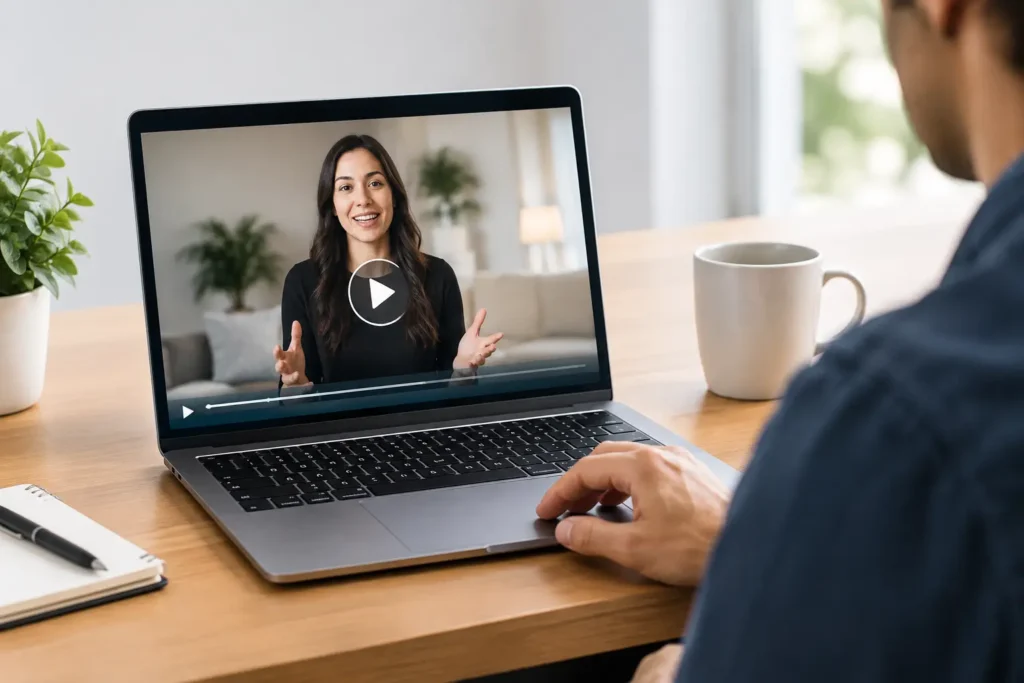
A landing page has a short window to earn attention. If visitors cannot quickly understand what you offer, why it matters, and what to do next, they leave. The best landing page videos solve that problem in seconds. They turn vague value propositions into clear stories that make the next click feel logical.
For B2B brands, the goal is not simply to make a page look more polished. It is to reduce hesitation. A strong video can show a complicated platform in use, explain an unfamiliar service, establish credibility, and move a prospect closer to a demo request or purchase.
What Makes a Landing Page Video Perform?
The strongest videos are built around the conversion goal of the page. A homepage video may introduce the brand and its promise. A product landing page may need to demonstrate one feature that solves a costly problem. A campaign page may need to create urgency around a specific offer.
That focus matters because video is not automatically persuasive. A beautiful animation that delays the core message can hurt performance, especially when visitors arrive with limited patience. The first few seconds should answer a practical question: what is this, who is it for, and why should I care?
The best videos also make the next step obvious. A viewer should finish with a clearer understanding of the offer and a reason to complete the form, book a call, start a trial, or explore the product.
10 Best Landing Page Video Formats for Conversion
1. The Clear Value Proposition Video
This is the most useful format for brands with a strong offer that is difficult to explain in a headline alone. In 30 to 60 seconds, the video names the audience’s problem, introduces the solution, and shows the outcome.
For example, a cybersecurity provider might open with the operational risk of scattered security alerts, then show how its platform prioritizes threats and gives teams faster visibility. The story stays focused on the business benefit, not a long product tour.
2. The Product Demo Video
Product demos work especially well when buyers need proof that the product is practical, intuitive, or feature-rich. Screen recordings, motion graphics, and guided narration can show exactly how a user moves from problem to result.
The trade-off is detail. A full demo can overwhelm first-time visitors. For a landing page, focus on the one or two moments that make the product valuable. Save deeper walkthroughs for a resource center, sales call, or post-signup experience.
3. The Problem-Solution Explainer
An explainer video is a smart choice for technical products, new categories, and service businesses with an abstract offer. It gives the audience useful context before asking them to evaluate your solution.
Start with the friction your audience recognizes. Then explain the shift your business creates. Animated visuals are particularly effective here because they can simplify workflows, data flows, technical processes, and concepts that are hard to film.
4. The Customer Story Video
Prospects trust a customer who faced the same challenge. A concise customer story can show the before-and-after transformation: the inefficient process, the decision to change, and the measurable outcome.
This format is strongest when it is specific. “Our clients save time” is forgettable. “We cut onboarding from three weeks to five days” gives the claim weight. If formal customer footage is unavailable, a motion-graphics case study can still present the narrative clearly using approved results and brand visuals.
5. The Founder or Expert Message
For consulting firms, high-consideration services, and emerging brands, an on-camera expert can build confidence quickly. Viewers see the people behind the promise and hear a direct explanation of the company’s point of view.
Keep the delivery focused. The speaker should address the visitor’s concern, not recite company history. A brief expert introduction paired with supporting visuals often performs better than a static talking-head video alone.
6. The 3D Product Visualization
Some products are hard to capture in a conventional video. They may be still in development, too small to film clearly, too large to stage, or too complex to understand from a photo. A 3D animation can reveal internal components, product mechanics, and use cases with precision.
This approach is valuable for manufacturing, healthcare, software infrastructure, engineering, and product launches. It creates clarity while giving the page a premium visual presence. It does require thoughtful scripting, though. Visual sophistication should support the selling point rather than compete with it.
7. The Whiteboard Video
Whiteboard videos are effective when education is the conversion lever. Their simple, progressive visual style helps viewers follow a sequence of ideas without unnecessary visual clutter.
They can be particularly useful for financial services, professional services, training platforms, and complex B2B solutions. Use them when your audience needs to understand a process before they can appreciate the value of your offer.
8. The Feature Launch Video
When the landing page promotes a new capability, update, or limited campaign, a focused launch video can create momentum. It should identify what is new, explain why it matters, and show how it changes the customer experience.
Avoid trying to cover every release note. The page needs a compelling reason to act now. Lead with the feature’s impact, then support it with a concise visual demonstration and a call to action that matches the campaign.
9. The Social Proof Montage
A social proof video brings together testimonials, customer logos, outcomes, review excerpts, and short clips of real users. It gives visitors a fast sense that other businesses have already made the decision with confidence.
This format works well near pricing, form fields, or a decision-point section of the page. It is most credible when it includes recognizable details, such as customer roles, industries, or measurable wins, instead of generic praise.
10. The Personalized Sales Video
For account-based marketing or high-value lead generation, personalized landing page videos can make outreach feel far more relevant. A video may address a target industry, a buyer role, or even a specific prospect account with tailored language and visuals.
Personalization should be strategic, not superficial. Simply adding a company logo is rarely enough. The strongest version connects the prospect’s likely challenge to a relevant solution and gives them a clear reason to continue the conversation.
How to Choose the Right Video for Your Page
Start with the question your visitor is trying to answer. If they are unfamiliar with your category, an explainer video is often the right first move. If they already understand the problem but need to evaluate your product, a concise demo or 3D visualization may be more persuasive. If trust is the main barrier, lead with a customer story or expert message.
Placement also changes the creative approach. A hero video should make its point quickly, often with captions because many viewers will not enable sound. A mid-page video can provide more detail after the visitor has read the core value proposition. A video near a form should reinforce confidence and reduce the perceived risk of taking action.
Keep technical performance in view. Large, slow-loading video files can undermine the experience before the story begins. Use a strong thumbnail, optimize loading behavior, and make the opening frame understandable without audio. Captions are not just an accessibility feature. They help busy buyers absorb the message in quiet offices, crowded airports, and browser tabs competing for attention.
Build for the Click, Not Just the View
A high view count is not the same as a high-performing landing page video. Measure what happens after viewers watch: form starts, demo requests, trial registrations, page depth, and completed purchases. If viewers drop before the value proposition appears, tighten the opening. If they watch but do not convert, revisit the offer, call to action, or page-message alignment.
At AnimateWiz, we approach landing page animation as a sales asset, not a decorative add-on. That means beginning with the audience, the conversion goal, and the message that deserves to be remembered.
The right video does not need to say everything. It needs to make the next decision easier.